

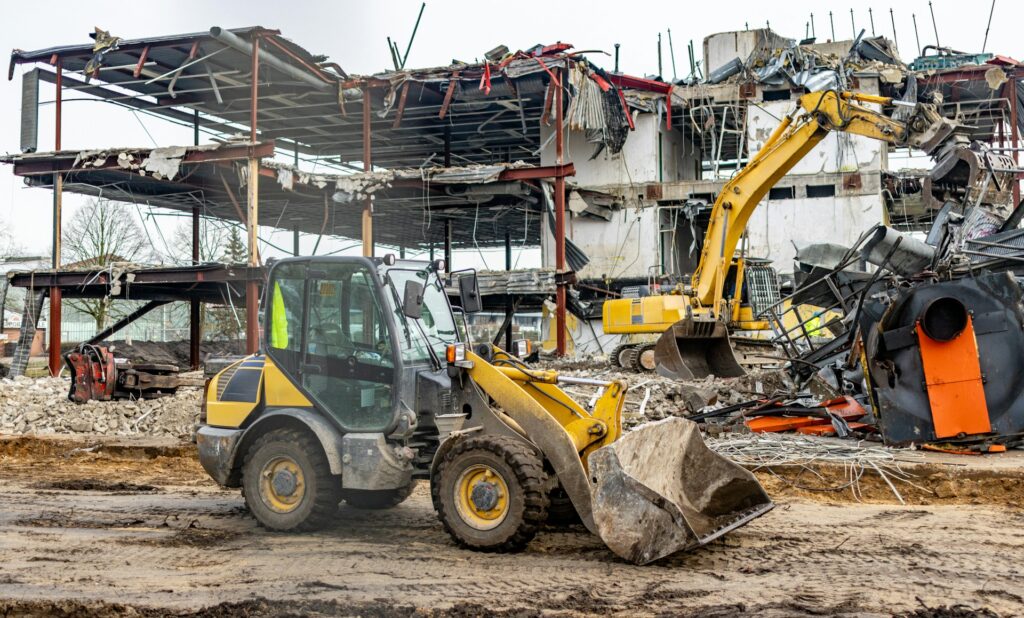
If you own commercial property in Charleston, SC and you are planning to demolish an existing structure, the process involves considerably more than scheduling a contractor and stepping back. Property owners carry real responsibilities in a commercial demolition project, from permit applications and environmental clearances to coordinating utilities and managing what happens to the site after the structure comes down.
This guide explains how commercial demolition works from the property owner’s vantage point: what decisions you need to make, what the process looks like at each stage, and how to avoid the mistakes that cause projects to go over budget or stall in the planning phase.
Why Property Owners Need to Understand the Process
A contractor handles the physical demolition. You handle everything that makes the demolition possible.
That includes obtaining required permits, authorizing utility disconnections, providing access to environmental reports, making decisions about how to handle hazardous materials if found, and confirming what comes next for the site. Contractors who show up to a site where utilities have not been properly disconnected, environmental clearances have not been obtained, or permits have not been issued cannot legally begin work, and any delay at that stage comes out of your schedule and your budget.
Understanding the process early means you can initiate the right steps in the right order, rather than discovering what was missing after you thought the project was ready to go.
Step 1: Define the Scope of Demolition
Before anything else, be clear about what is being demolished and what the site needs to look like when demolition is complete.
The scope should specify:
- Whether demolition is full (entire structure removed to grade) or selective (partial removal while preserving certain elements)
- Whether the foundation is being demolished and removed or left in place
- What happens to demolition debris (disposal, recycling, or salvage)
- What the site condition should be at completion: cleared and graded flat, filled to a specific elevation, or prepared for immediate construction
The answer to that last question matters for cost. A structure demolished and hauled away, with the site left rough-cleared, costs less than a site that is demolished, graded, and prepared for a concrete foundation pour. Being specific about end-state avoids scope disputes after the fact.
Step 2: Commission an Environmental Assessment
Before any commercial structure is demolished in South Carolina, you need to know whether hazardous materials are present. For most structures built before 1980, this is not optional.
Common hazardous materials found in older commercial structures include:
- Asbestos — present in insulation, floor tiles, ceiling tiles, roofing materials, and pipe insulation
- Lead paint — common on interior and exterior surfaces in pre-1978 buildings
- PCBs — found in some electrical equipment, fluorescent light ballast, and older caulking
- Mold — often found in structures with water damage or long vacancy periods
If hazardous materials are present, they must be abated by a licensed hazardous materials contractor before general demolition can begin. You cannot combine abatement and demolition in the same scope without specialized licensing. Environmental abatement adds cost and timeline to a project, but attempting to demolish without it creates serious legal and health exposure.
A Phase I Environmental Site Assessment and, where indicated, a Phase II or hazardous materials survey should be completed and reviewed before you sign a demolition contract.
Step 3: Utility Disconnection
Utility lines, gas mains, electrical services, water, and sewer connections must be formally disconnected before demolition begins. This is not the same as simply turning off service at the meter.
Formal disconnection means:
- Gas lines are capped at the main by the gas utility provider
- Electrical service is disconnected and the meter is removed by the utility
- Water and sewer connections are abandoned or capped per the requirements of the local authority
Your demolition contractor will coordinate much of this, but the utility work requires contact with each provider, and lead times can range from a few days to several weeks depending on the utility and the scope of disconnection. Initiating these contacts early keeps your project on schedule.
Charleston Water System, Dominion Energy, and local telecom providers all have their own disconnection processes. Do not assume your contractor handles all of this without confirming it in writing as part of the contract scope.
Step 4: Obtain Required Permits
Commercial demolition in South Carolina requires permits. The specific permits depend on the location, the size and type of structure, and the extent of land disturbance associated with the project.
Demolition permit: Required from the local building department (City of Charleston, Charleston County, or the applicable municipality) for most commercial structure removals. You or your contractor will submit an application with site information and a description of the demolition scope. Review timelines vary, but allow several weeks minimum.
Land disturbance permit: If demolition is followed by grading or site work that disturbs an acre or more, a land disturbance permit from SCDHEC is required. This permit requires a Stormwater Pollution Prevention Plan (SWPPP) and an approved erosion and sediment control plan. Your site contractor handles erosion control in the field, but the permit is initiated by the property owner or developer.
SCDHEC notification: For asbestos abatement, SCDHEC requires written notification at least ten working days before demolition begins when asbestos-containing materials are present above threshold quantities. This is a legal requirement, not a courtesy notice.
Permit applications take time. Start the permitting process in parallel with environmental assessment, not after it.
Step 5: Select and Contract a Demolition Contractor
Once you have your environmental assessment, know your permit requirements, and have initiated utility disconnection, you are in a position to select a demolition contractor and negotiate a contract.
When evaluating demolition contractors, confirm:
Licensing: South Carolina requires commercial demolition contractors to hold the appropriate contractor’s license through the SC Contractor’s Licensing Board. Verify before signing.
Insurance: Commercial demolition requires substantial liability insurance coverage and workers’ compensation. Request certificates of insurance, not verbal assurances.
Experience with similar structures: A contractor who primarily demolishes wood-frame residential buildings is not the right choice for a multi-story commercial structure or a building with complex structural systems. Ask specifically about similar commercial projects in the Charleston market.
What is included: The contract should specify exactly what is being demolished, how debris is handled, what happens to the foundation, what site conditions will look like at project completion, and who is responsible for permit applications and utility coordination.
What is not included: Exclusions matter as much as inclusions. Confirm whether hazardous material abatement, utility disconnection coordination, permit fees, and debris hauling beyond a certain volume are included or separate cost items.
Step 6: The Demolition Phase
Once permits are in hand, utilities are disconnected, and environmental abatement is complete, physical demolition can begin.
The general sequence on a commercial demolition project:
- Site preparation — temporary fencing, traffic control, erosion control measures, and equipment staging
- Salvage — if any materials are being salvaged for reuse or resale (structural steel, equipment, etc.), this happens before general demolition begins
- Interior strip-out — non-structural interior components are removed first when doing selective or partial demolition
- Structural demolition — the structural frame is brought down using excavators, high-reach equipment, or controlled implosion for large structures
- Foundation demolition — if in scope, foundations are broken up and removed
- Debris processing and hauling — materials are separated, recyclables are diverted where possible, and remaining debris is hauled to an approved disposal facility
- Site cleanup and rough grading — the site is cleared of debris and rough-graded to the specified end condition
For a typical commercial structure in the Charleston area, active demolition can take anywhere from a few days to several weeks depending on structure size and complexity. Foundation removal and grading add additional time.
Step 7: Site Preparation for What Comes Next
Demolition creates a cleared site. What happens next depends on your plans for the property.
If you are redeveloping the site for a new commercial use, the post-demolition phase involves:
- Grading to establish the rough grade for new construction
- Drainage infrastructure to manage stormwater before and during construction
- Excavation for new foundations if the existing foundation was removed
- Utility connections for the new structure
- Asphalt or concrete paving for access roads, parking, and site circulation
Simmons Construction handles demolition, land clearing, grading, excavation, and commercial asphalt paving as an integrated scope. Having one contractor handle the full site development sequence simplifies coordination and reduces the risk of scope gaps between trades.
Frequently Asked Questions
How much does commercial demolition cost in Charleston, SC? Commercial demolition costs vary significantly based on structure size, type, complexity, and what the site needs to look like at completion. Hazardous material abatement, foundation removal, and post-demolition grading all add cost. Request itemized estimates from qualified contractors rather than relying on per-square-foot averages, which rarely capture site-specific factors accurately.
How long does commercial demolition take? Active demolition of most single-story commercial structures takes one to two weeks once work begins. Multi-story or structurally complex buildings take longer. The pre-demolition phase, including environmental assessment, permitting, and utility disconnection, typically takes four to eight weeks and often determines the overall project timeline more than the physical demolition itself.
Who pulls the demolition permit in South Carolina? Either the property owner or a licensed contractor can pull a demolition permit in South Carolina. In most cases, the demolition contractor handles permit applications as part of their scope. Confirm this in writing in your contract.
What happens to demolition debris? Demolition contractors separate, haul, and dispose of debris at approved facilities. Recyclable materials including concrete, metal, and wood may be diverted from landfill. Some structural elements have salvage value. Your contractor should be transparent about how debris is handled. Verify that disposal is happening at properly permitted facilities to avoid any liability associated with illegal dumping.
Does the foundation need to be removed? Not always. Whether to remove an existing foundation depends on the planned use for the site, the condition of the foundation, and engineering assessment of whether it can be incorporated into new construction. In some cases, leaving a sound foundation in place saves cost. In others, removing it is necessary to prepare the site properly for redevelopment. Your contractor and civil engineer can advise based on your specific plans.
Commercial demolition is a manageable process when you understand your responsibilities as a property owner and initiate the right steps in the right order. The projects that run smoothly are the ones where environmental clearance, permits, and utility coordination happen before the contractor shows up on day one.
Contact Simmons Construction to discuss your commercial demolition project in Charleston, SC.