

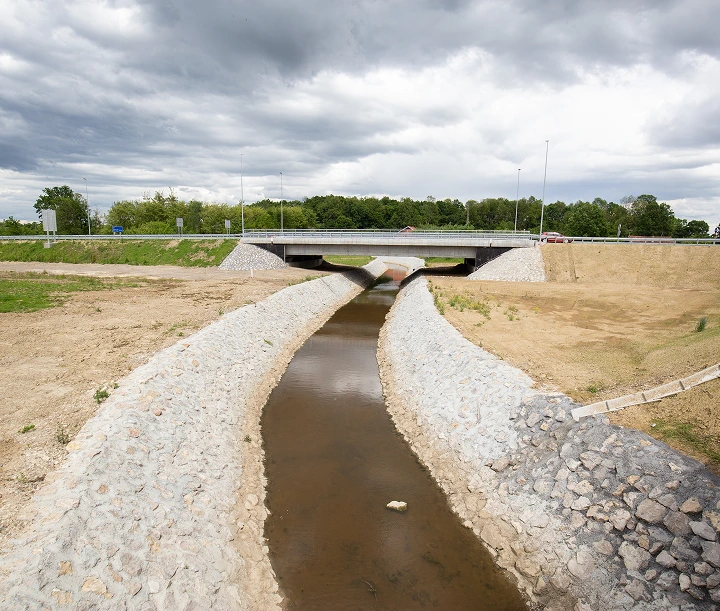
Grading is the part of a commercial build that almost never shows up in the finished photos, and it’s also the part that determines whether the parking lot floods in year two, whether the slab cracks, and whether the drainage inspector signs off on the first try. Get it wrong, and the mistake is buried under concrete and asphalt where it’s expensive to fix. Get it right, and nobody ever thinks about it again, which is exactly the point.
For commercial developers, general contractors, and property managers planning a build in the Charleston area, grading and drainage aren’t separate line items to check off. They’re one connected system, and Charleston’s flat topography, high water table, and coastal rainfall totals make that system more consequential here than in most inland markets. This guide walks through what site grading actually involves, how it works together with drainage design, and what Charleston’s specific conditions mean for your project’s timeline and budget.
What Is Site Grading and Why It Matters for Commercial Construction
Site grading is the process of reshaping and leveling the ground surface to prepare a site for construction. On a commercial project, grading has to accomplish three things at once: create a stable, load-bearing surface for foundations and paving, direct water runoff away from structures and toward the drainage system that’s supposed to receive it, and establish the slope and elevation an engineer specified on the civil drawings.
Grading typically happens in two passes. Rough grading establishes the approximate elevation and slope across the site, moving the bulk of the material to get close to the design grade. Fine grading follows, bringing the surface within inches of the exact specification needed for foundations, concrete flatwork, or paving. Skipping straight to fine grading on a raw site, or treating grading as a single pass instead of two, is one of the more common ways a project ends up needing rework later.
On most commercial sites, grading picks up right where land clearing leaves off, and the handoff between the two is where problems tend to start if it isn’t planned as one continuous scope. A site that’s been cleared but not graded to the civil engineer’s actual elevations is still, functionally, an unbuildable lot. For a wider view of how grading fits into everything else that happens before vertical construction starts, our breakdown of what site work actually covers walks through the full sequence.
How Grading and Drainage Work Together
Grading and drainage aren’t sequential trades that happen to sit next to each other on the schedule. They’re designed as a single system from the start. The grading plan establishes the slopes that move water toward inlets, swales, or retention areas, and the drainage plan sizes and locates the infrastructure that receives that water once it arrives. Change one without checking the other, and you get standing water in a corner of the lot that “should” have drained, or a storm structure that’s correctly sized but sitting at the wrong elevation to actually catch the flow it was designed for.
This is why an experienced site contractor walks grading and drainage as one scope rather than bidding them separately and hoping the transitions line up. Simmons Construction coordinates grading and drainage design and installation as an integrated scope specifically because a grading error and a drainage error usually trace back to the same root cause: nobody owned the whole system.
Grading Standards for Commercial Sites in South Carolina
Commercial grading in South Carolina has to satisfy two separate sets of requirements at once. The first is structural: your geotechnical engineer’s compaction and subgrade specifications, which exist to make sure the finished surface can actually bear the load of the building, the parking lot, or the industrial pavement sitting on top of it. The second is regulatory: South Carolina treats grading, clearing, and excavating as regulated land-disturbing activity once a project crosses certain thresholds, and any site disturbing one acre or more (or part of a larger common plan that will eventually disturb an acre or more) needs coverage under the state’s Construction General Permit for stormwater discharges.
In practice, that means your grading plan and your Stormwater Pollution Prevention Plan get reviewed together, not as two disconnected documents. A grading plan that doesn’t account for how it will be inspected against the SWPPP tends to generate change orders once the civil engineer’s comments come back. The erosion and sediment control measures required under that same permit, silt fencing, inlet protection, and sediment basins, have to go in before grading disturbs the site, not after.
Types of Drainage Systems Used in Commercial Construction
Most commercial sites in the Charleston area combine several of the following, depending on site size, soil conditions, and what the local jurisdiction requires:
French drains and subsurface drainage. Perforated pipe set in gravel that intercepts groundwater or moves subsurface water away from saturated areas before it reaches a foundation or pavement base.
Storm drainage piping and structures. Catch basins, inlets, and piped networks that collect surface runoff and carry it to a discharge point, a detention facility, or a municipal system.
Retention and detention ponds. Larger properties frequently need engineered ponds that hold stormwater temporarily (detention) or permanently (retention) to control the rate and volume of runoff leaving the site. Building one usually means significant excavation beyond what the building pad itself requires, and it’s often the single biggest driver of whether a commercial site meets its local stormwater ordinance.
Grading-based sheet flow and swales. Not every drop of water needs a pipe. Properly graded swales and sloped surfaces can move water to a collection point on their own, which is often the most cost-effective drainage a site can have, provided the grading is actually correct.
Gutter and downspout systems tied into site drainage. Building-level drainage still has to connect logically into the broader site plan so roof runoff doesn’t dump directly onto a grade that wasn’t designed to receive it.
Charleston-Specific Challenges: High Water Table, Coastal Flooding, and Clay Soil
Charleston’s geography changes the grading and drainage conversation in ways that don’t apply to most inland markets.
High water table. Much of the Lowcountry sits close to the water table, which limits how much subsurface drainage infrastructure (like deep French drains) can accomplish on its own and puts more weight on surface grading to move water where it needs to go.
Flat topography. Charleston’s relatively flat terrain keeps earthwork costs down compared to hillier markets, but it raises the stakes on drainage planning. Water has to go somewhere, and on a flat lot that “somewhere” has to be engineered rather than assumed. A quarter-inch grading error that would be invisible on a sloped site can create a standing puddle on a flat one.
Heavy, seasonal rainfall. The Charleston area sees roughly 50 inches of rain a year, concentrated heavily in the summer months, plus a hurricane season that runs June through November. Drainage systems sized for an “average” rain event routinely get overwhelmed by the storm intensity this region actually sees.
Clay and soft coastal soils. Compaction behaves differently in Lowcountry clay and historic fill than it does in sandier inland soil. A grading and drainage plan copied from a project in another region without accounting for local soil behavior is a common source of post-construction settling and pooling.
How Poor Grading Leads to Foundation Issues and Asphalt Failure
The cost of a grading mistake rarely shows up during grading. It shows up months or years later, in the trades that had to build on top of the mistake.
Improper grading that lets water pool against a building’s perimeter is one of the most common causes of foundation moisture problems, and it’s almost always cheaper to fix in the grading phase than to correct after the slab and walls are in place. On the paving side, grading that doesn’t establish the correct slope and base drainage leads directly to some of the most common commercial asphalt failures: base saturation, potholing, and premature cracking, especially in a climate like Charleston’s where the asphalt surface is already dealing with heat, humidity, and heavy rainfall. Fixing a drainage problem after paving usually means milling and repaving the affected area, which costs far more than getting the grade right the first time.
The Grading and Drainage Process: From Survey to Final Grade
A well-run grading and drainage scope on a commercial project generally follows this sequence:
- Survey and geotechnical review. Establishing existing elevations, soil conditions, and the civil engineer’s target grades before any equipment moves.
- Erosion and sediment control installation. Silt fencing, inlet protection, and other measures go in before major ground disturbance, both because it’s required and because it protects the site from its own construction activity.
- Rough grading. Bulk earthmoving to bring the site to approximate elevation and establish the general slope pattern.
- Drainage infrastructure installation. Storm piping, structures, and any retention or detention features get installed once rough grades are in place, coordinated with utility trenching so nothing gets cut twice.
- Fine grading. Precision work that brings the surface within the tight tolerances required for foundations, concrete flatwork, and paving subgrade, with the finished slopes matching the drainage design exactly.
- Proof-rolling and inspection. Testing to confirm compaction and drainage performance meet the geotechnical and civil specifications before the next trade takes over the site.
Sequencing this correctly matters as much as executing each step well. Fine-grading a pad before the drainage piping underneath it is finalized, for example, invites exactly the kind of rework this whole process exists to prevent.
What to Expect on Timeline and Cost
Timeline and cost both depend heavily on site size, existing soil conditions, and how much of the drainage infrastructure the project requires. A straightforward commercial grading and drainage scope on a cleared, moderately sized site can move from rough grade to finished grade in a matter of weeks. Sites requiring significant cut-and-fill, retention pond construction, or extensive storm piping take longer, and Charleston’s rainfall pattern routinely adds real days to any schedule that doesn’t budget for wet-weather delays.
Cost varies by the same factors: soil conditions, the amount of earthwork required, the scope of drainage infrastructure, and whether the site needs a retention or detention facility versus simpler swale-based drainage. A site-specific walk-through from an experienced Charleston contractor is the only reliable way to get a real number, since a desk estimate misses the soil and drainage conditions that actually drive the price on Lowcountry sites. If your project is still in the phase before this one, our land clearing cost and timeline guide covers the budgeting conversation that typically happens just before grading begins.
Working With a Grading and Drainage Contractor in Charleston
Vet a grading and drainage contractor the same way you’d vet any trade with this much downstream impact: licensing, insurance, equipment inventory suited to the project’s scale, and references on comparable commercial or industrial work. Ask specifically how they coordinate grading with drainage design rather than treating them as separate bids, since that coordination is where most of the schedule and cost savings actually come from.
Simmons Construction has been grading and draining commercial and industrial sites across Charleston for nearly four decades, using laser-guided grading equipment and GPS-equipped dozers to hold tight tolerances on sites of every scale. That local experience covers the specific soil conditions, water table depth, and rainfall patterns that make Charleston grading different from grading almost anywhere else in the state, and it’s the same reason our crews handle clearing, grading, drainage, and erosion control as one coordinated scope rather than separate bids that have to line up after the fact.
That coordination matters even more in drainage-sensitive parts of the Lowcountry, where soil and water table conditions can vary from one block to the next. Our North Charleston team handles this regularly, along with projects further out toward Orangeburg, and the City of Charleston’s Stormwater Management program is worth reviewing early if your site falls within city limits, since local drainage design standards can add requirements on top of the state permit.
Planning a commercial site in the Charleston area? Request a site assessment and we’ll walk the grading and drainage plan with you before the first cut is made.
Frequently Asked Questions
What is the difference between grading and drainage?
Grading is the physical shaping of the land, establishing elevations and slopes. Drainage is the system, pipes, structures, ponds, or engineered swales, that receives and moves the water once grading has directed it there. Neither works correctly without the other, which is why they’re designed and often bid together on commercial projects.
Why does grading matter so much in a flat, coastal market like Charleston?
On flat terrain, water doesn’t find its own way to a low point the way it might on a sloped site. It has to be directed there deliberately through precise grading. Combined with Charleston’s high water table and heavy seasonal rainfall, small grading errors on flat sites tend to show up as standing water much faster than they would in a hillier market.
Do I need a permit for commercial site grading in South Carolina?
In almost every case, yes. Grading, clearing, and excavating are treated as regulated land-disturbing activity once a project crosses the state’s acreage thresholds, which means coverage under South Carolina’s Construction General Permit and a reviewed Stormwater Pollution Prevention Plan. Projects within Charleston city limits or Charleston County may also need to meet additional local drainage design standards.
How long does commercial grading and drainage work take?
A straightforward site can move from rough grade to finished grade in a matter of weeks. Larger sites, significant cut-and-fill requirements, or projects that need a retention or detention pond take longer, and Charleston’s rainfall pattern should be built into the schedule as a real variable, not an afterthought.
What happens if grading is done incorrectly on a commercial site?
Poor grading is one of the leading causes of water pooling against foundations, drainage violations, and premature asphalt failure from base saturation. Because grading sits underneath everything built on top of it, correcting a grading mistake after the fact, once foundations, utilities, or paving are in, is almost always more expensive than getting it right during the original scope.
Can grading and drainage be handled by separate contractors?
They can, but coordinating both under one contractor tends to reduce the risk of a mismatch between the final grade and the drainage infrastructure designed to work with it. When one company owns both scopes, there’s a single point of accountability if the finished elevations and the drainage design don’t line up.